

While NASA retired its InSight Mars lander in December, the trove of data from its seismometer will be pored over for decades to come. By looking at seismic waves the instrument detected from a pair of temblors in 2021, scientists have been able to deduce that Mars’ liquid iron core is smaller and denser than previously thought.
The findings, which mark the first direct observations ever made of another planet’s core, were detailed in a paper published April 24 in the Proceedings of the National Academies of Sciences. Occurring on Aug. 25 and Sept. 18, 2021, the two temblors were the first identified by the InSight team to have originated on the opposite side of the planet from the lander – so-called farside quakes. The distance proved crucial: The farther a quake happens from InSight, the deeper into the planet its seismic waves can travel before being detected.
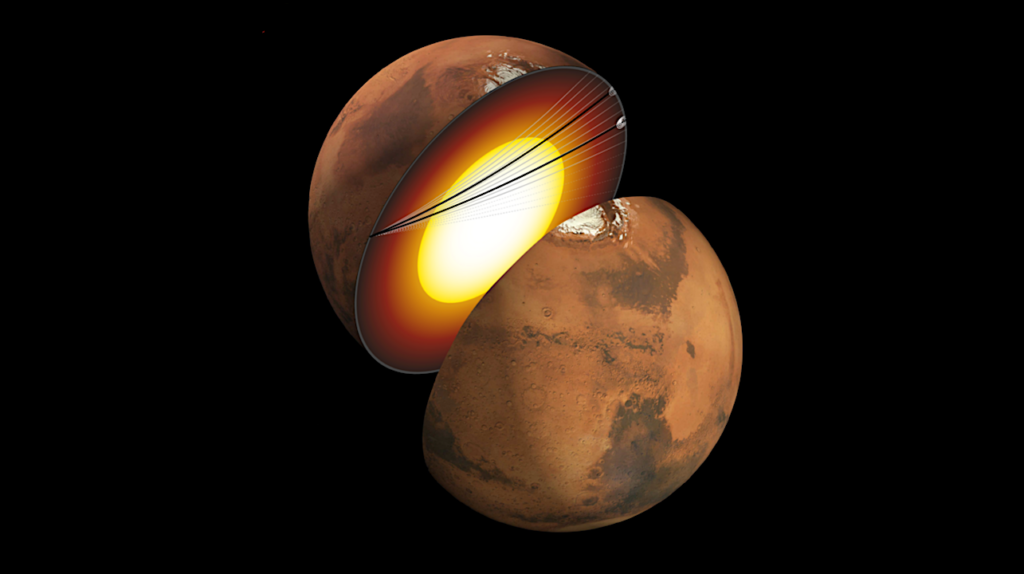
“We needed both luck and skill to find, and then use, these quakes,” said lead author Jessica Irving, an Earth scientist at the University of Bristol in the United Kingdom. “Farside quakes are intrinsically harder to detect because a great deal of energy is lost or diverted away as seismic waves travel through the planet.”
Irving noted that the two quakes occurred after the mission had been operating on the Red Planet for well over a full Martian year (about two Earth years), meaning the Marsquake Service – the scientists who initially scrutinize seismographs – had already honed their skills. It also helped that a meteoroid impact caused one of the two quakes; impacts provide a precise location and more accurate data for a seismologist to work with. (Because Mars has no tectonic plates, most marsquakes are caused by faults, or rock fractures, that form in the planet’s crust due to heat and stress.) The quakes’ size was also a factor in the detections.
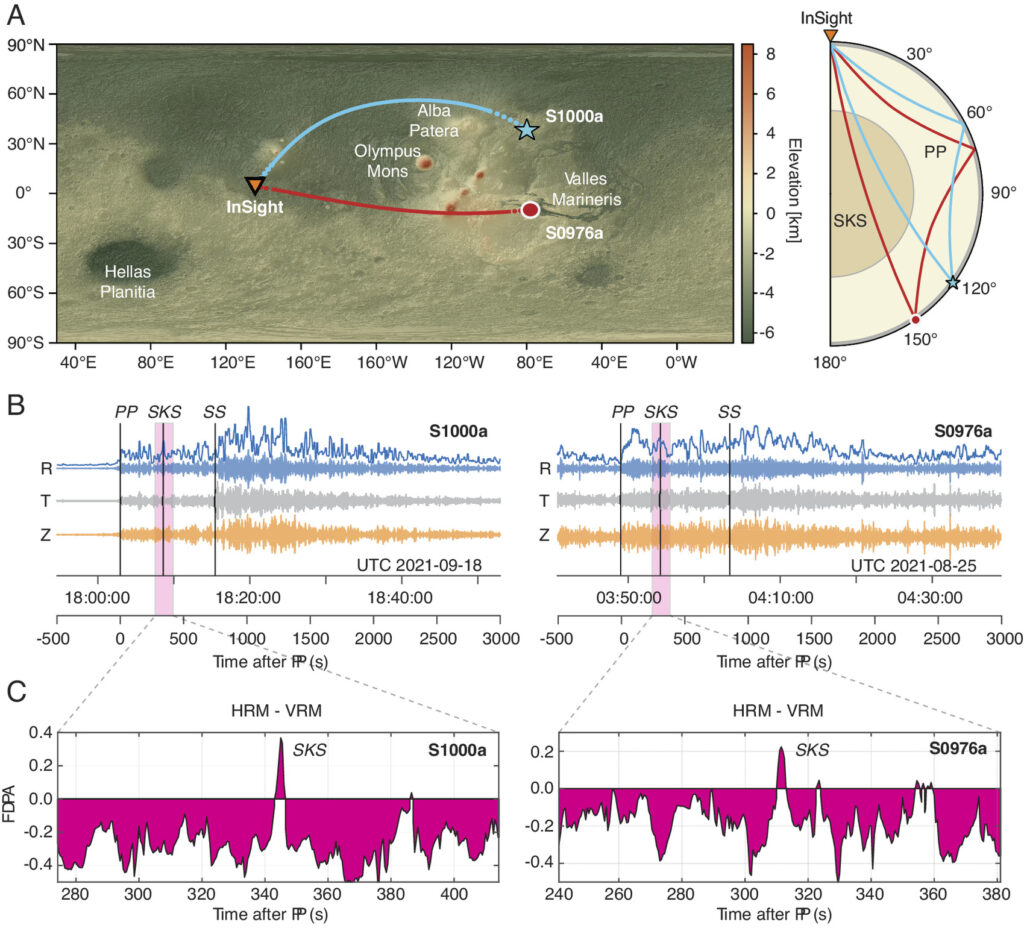
“These two farside quakes were among the larger ones heard by InSight,” said Bruce Banerdt, InSight’s principal investigator at NASA’s Jet Propulsion Laboratory in Southern California. “If they hadn’t been so big, we couldn’t have detected them.”
One of the challenges in detecting these particular quakes was that they’re in a “shadow zone” – a part of the planet from which seismic waves tend to be refracted away from InSight, making it hard for a quake’s echo to reach the lander unless it is very large. Detecting seismic waves that cross through a shadow zone is exceptionally difficult; it’s all the more impressive that the InSight team did so using just the one seismometer they had on Mars. (In contrast, many seismometers are distributed on Earth.)
“It took a lot of seismological expertise from across the InSight team to tease the signals out from the complex seismograms recorded by the lander,” Irving said.
A previous paper that offered a first glimpse of the planet’s core relied on seismic waves that reflected off its outer boundary, providing less precise data. Detecting seismic waves that actually traveled through the core allows scientists to refine their models of what the core looks like. Based on the findings documented in the new paper, about a fifth of the core is composed of elements such as sulfur, oxygen, carbon, and hydrogen.
“Determining the amount of these elements in a planetary core is important for understanding the conditions in our solar system when planets were forming and how these conditions affected the planets that formed,” said one of the paper’s co-authors, Doyeon Kim of ETH Zurich.
That was always the central goal of InSight’s mission: to study the deep interior of Mars and help scientists understand how all rocky worlds form, including Earth and its Moon.
More About the Mission
JPL manages InSight for NASA’s Science Mission Directorate. InSight is part of NASA’s Discovery Program, managed by the agency’s Marshall Space Flight Center in Huntsville, Alabama. Lockheed Martin Space in Denver built the InSight spacecraft, including its cruise stage and lander, and supported spacecraft operations for the mission.
A number of European partners, including France’s Centre National d’Études Spatiales (CNES) and the German Aerospace Center (DLR), are supporting the InSight mission. CNES provided the Seismic Experiment for Interior Structure (SEIS) instrument to NASA, with the principal investigator at IPGP (Institut de Physique du Globe de Paris). Significant contributions for SEIS came from IPGP; the Max Planck Institute for Solar System Research (MPS) in Germany; the Swiss Federal Institute of Technology (ETH Zurich) in Switzerland; Imperial College London and Oxford University in the United Kingdom; and JPL. The Marsquake Service is headed by ETH Zurich, with significant contributions from IPGP; the University of Bristol; Imperial College; ISAE (Institut Supérieur de l’Aéronautique et de l’Espace); MPS; and JPL. DLR provided the Heat Flow and Physical Properties Package (HP3) instrument, with significant contributions from the Space Research Center (CBK) of the Polish Academy of Sciences and Astronika in Poland. Spain’s Centro de Astrobiología (CAB) supplied the temperature and wind sensors.