
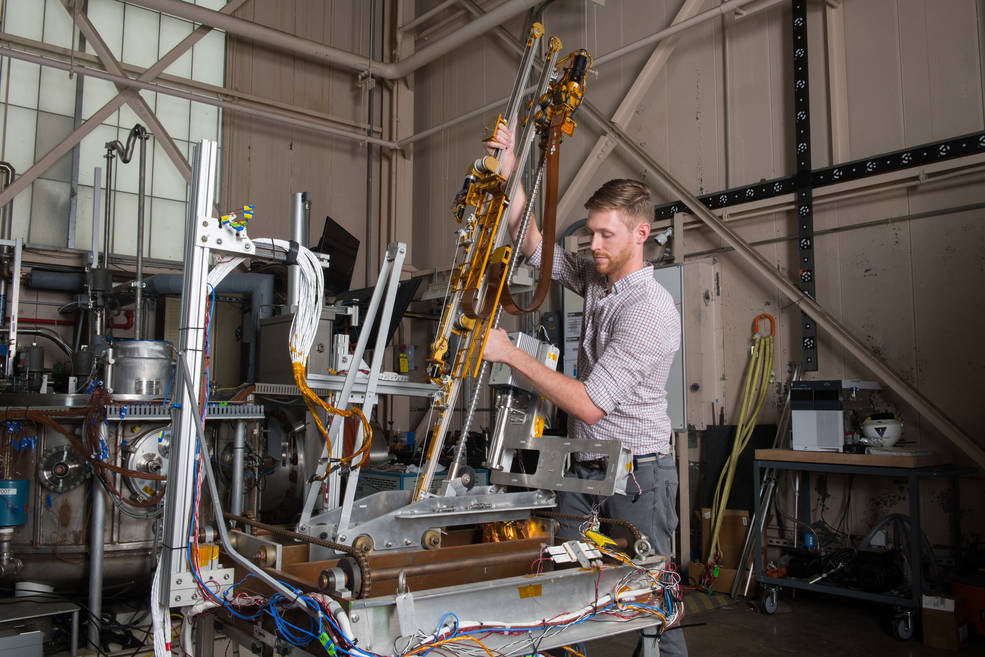
NASA has awarded Intuitive Machines of Houston approximately $47 million to deliver a drill combined with a mass spectrometer to the Moon by December 2022 under the agency’s Commercial Lunar Payload Services initiative. The delivery of the Polar Resources Ice Mining Experiment known as PRIME-1 will help NASA search for ice at the Moon’s South Pole and, for the first time, harvest ice from below the surface.
“We continue to rapidly select vendors from our pool of CLPS vendors to land payloads on the lunar surface, which exemplifies our work to integrate the ingenuity of commercial industry into our efforts at the Moon,” said NASA’s Associate Administrator for Science Thomas Zurbuchen. “The information we’ll gain from PRIME-1 and other science instruments and technology demonstrations we’re sending to the lunar surface will inform our Artemis missions with astronauts and help us better understand how we can build a sustainable lunar presence.”
PRIME-1 will land on the Moon and drill up to 3 feet (approximately 1 meter) below the surface. It will measure with a mass spectrometer how much ice in the sample is lost to sublimation as the ice turns from a solid to a vapor in the vacuum of the lunar environment. Versions of PRIME-1’s drill and the Mass Spectrometer Observing Lunar Operations, or MSolo, will also fly on VIPER, a mobile robot that also will search for ice at the lunar South Pole in 2023. NASA will land the first woman and next man on the Moon’s South Pole the following year.
“PRIME-1 will give us tremendous insight into the resources at the Moon and how to extract them,” said Jim Reuter, associate administrator for NASA’s Space Technology Mission Directorate (STMD) in Washington. “Sending this payload to the Moon is a terrific example of our scientific and technology communities coming together with our commercial partners to develop breakthrough technologies to accomplish a range of goals on the lunar surface.”
STMD’s Game Changing Development program funds PRIME-1. Honeybee Robotics of Pasadena, California, is developing the ice-mining drill. NASA’s Kennedy Space Center in Florida, in partnership with INFICON of Syracuse, New York, is developing the mass spectrometer.
The data from PRIME-1 will help scientists understand in-situ resources on the Moon. PRIME-1 contributes to NASA’s search for water at the Moon’s poles, supporting the agency’s plans to establish a sustainable human presence on the Moon by the end of the decade. PRIME-1’s early use of the drill and MSolo helps to increase the likelihood of reliable operation of those payloads on VIPER’s mobile platform in the following year.
Through the CLPS initiative, NASA taps its commercial partners to quickly land scientific instruments and technology demonstrations on the Moon with the first flights set for next year. A key part of NASA’s Artemis program, CLPS flights will support a suite of robotic lunar activities ahead of a human return to the Moon as well as throughout this decade.
For more information, visit: